
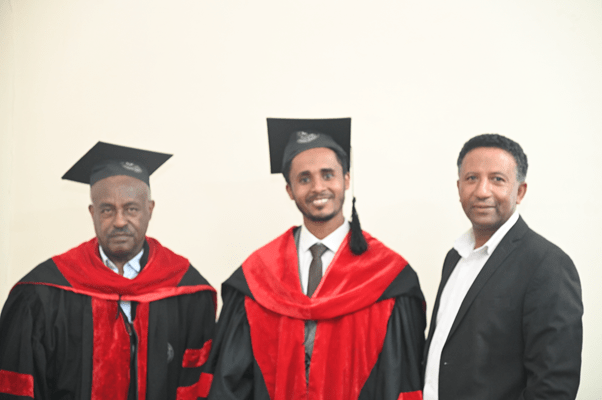
ACEWM PhD Candidate Tesfaye Muluye Workie Successfully Defended his Dissertation
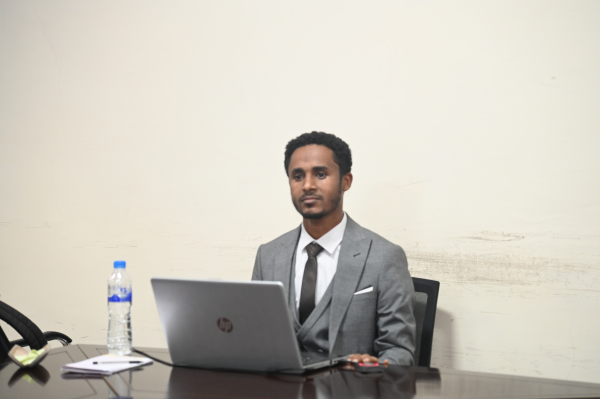
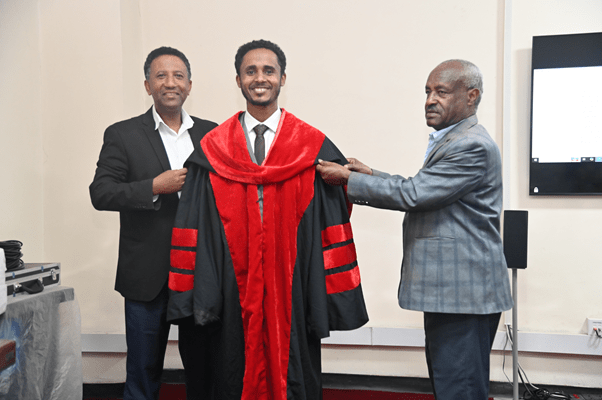
The Africa Center of Excellence for Water Management (ACEWM) at Addis Ababa University proudly announces the successful defense of PhD dissertation by its candidate, Tesfaye Muluye Workie. Tesfaye’s research, titled “Ecotoxicological Assessment and Biomonitoring Tool Development for the Awash River, Ethiopia: Integrating Water and Sediment Chemistry with Benthic Macroinvertebrate Responses”, marks a significant contribution to understanding and managing the ecological health of one of Ethiopia’s most vital water bodies.

Tesfaye’s study offers an integrated approach to assessing the Awash River by combining water and sediment chemistry analysis with the ecological responses of benthic macroinvertebrates. Spanning from September 2021 to April 2022, his fieldwork covered both the upper and middle reaches of the river, uncovering alarming levels of pollution downstream.
Key findings reveal substantial increases in nutrients such as soluble reactive phosphorus (SRP), total phosphorus (TP), and nitrate-nitrogen (NO₃-N), as well as potentially toxic elements (PTEs) like manganese (Mn), nickel (Ni), chromium (Cr), and copper (Cu). These concentrations were especially elevated near the inlet of Lake Koka. Furthermore, high levels of iron (Fe), boron (B), and zinc (Zn) were detected downstream of Lake Beseka and Metehara.
Through advanced multivariate statistical analyses, Tesfaye found strong correlations (r ≥ 0.80, p < 0.05) between nutrients and PTEs, suggesting shared pollution sources and potential interactive toxic effects. Alarmingly, sediment concentrations of cadmium (Cd), mercury (Hg), and chromium (Cr) exceeded Canadian/Ontario sediment quality standards, posing a severe threat to aquatic life.
The study also observed clear biological changes along the river. Upstream sites supported sensitive aquatic macroinvertebrates such as Caenidae and Hydropsychidae, while polluted downstream areas—characterized by low dissolved oxygen and high total suspended solids—were dominated by pollution-tolerant taxa like Chironomidae and Oligochaeta.
A notable achievement of the research is the development of ecoregion-specific Multimetric Indices (MMIs), including MMI-U for upper reaches and MMI-M for middle reaches. These indices serve as powerful biomonitoring tools tailored to Ethiopia’s unique river ecosystems and will be instrumental in tracking long-term ecological changes and informing policy decisions.
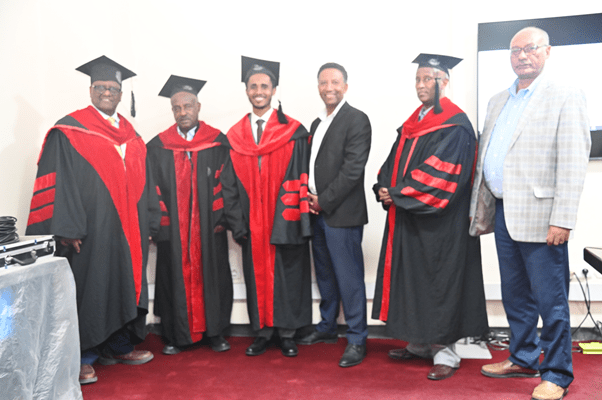
The dissertation defense was chaired by Prof. Abebe Getahun of Addis Ababa University and examined by Prof. Zinabu Gebremariam of Hawassa University (external examiner) and Dr. Demeke Kifle of Addis Ababa University (internal examiner). Tesfaye’s research was mainly supervised by Prof. Tadesse Fetahi and co-supervised by Prof. Seyoum Mengistou, both of Addis Ababa University.

Tesfaye’s work underscores the urgent need for integrated basin-wide water quality management to combat pollution, protect biodiversity, and ensure the sustainable use of water resources in the Awash River Basin. His research is expected to have far-reaching implications for environmental monitoring, water policy, and conservation efforts across Ethiopia.