
ACEWM’s PhD Candidate Flipos Engdaw Woldeab successfully defended his Dissertation
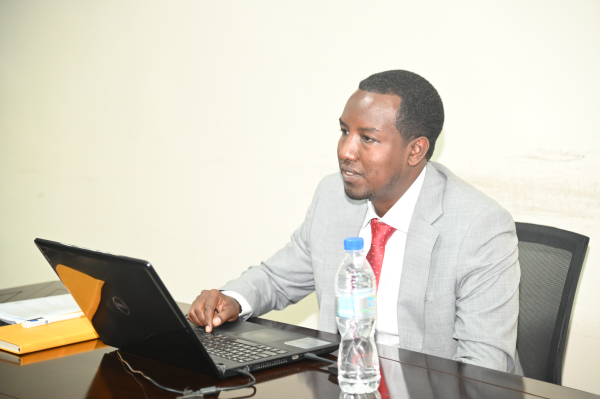
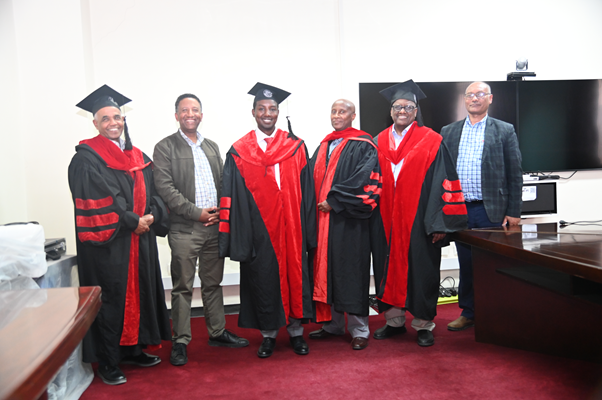
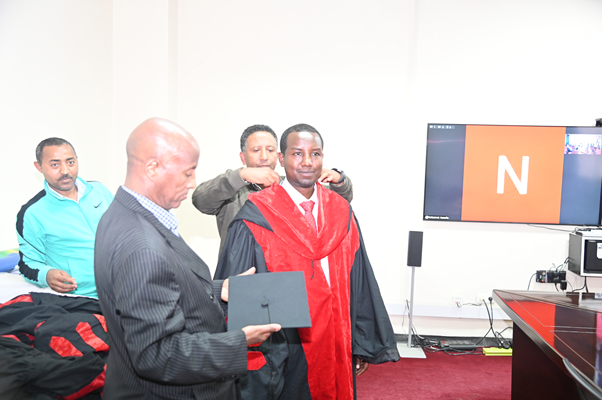
In a significant academic milestone, Flipos Engdaw Woldeab, a PhD candidate at the Africa Center of Excellence for Water Management (ACEWM), successfully defended his doctoral dissertation titled “Land Use/Land Cover Change, Water Quality and Plankton Community Structure in the Northern Gulf of Lake Tana, Ethiopia.”
Flipos’s research delves into the intricate relationship between land use/land cover (LU/LC) changes and their impacts on water quality and plankton diversity in the northern Gulf of Lake Tana, Ethiopia’s largest freshwater body and a critical ecological and economic resource.
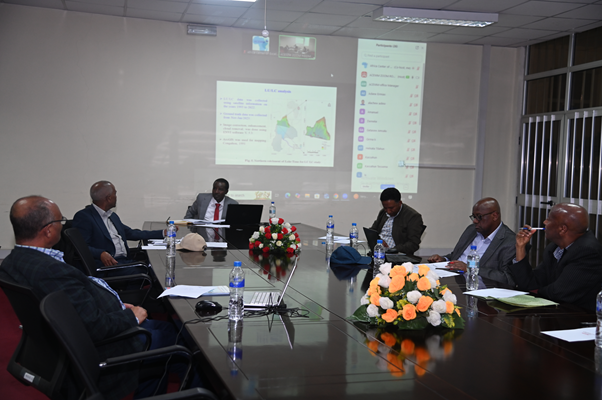
Using ArcGIS software and Landsat satellite imagery, he mapped LU/LC changes over time with remarkable accuracy (92.2%) and a Kappa coefficient of 0.86. His fieldwork, conducted from May 2023 to April 2024, included extensive water and plankton sampling, analyzed using internationally recognized methods.
The findings revealed that increasing settlement and cropland are directly linked to elevated nutrient levels—particularly ammonia, nitrates, and phosphates—some of which exceeded the U.S. Environmental Protection Agency’s eutrophication thresholds. These nutrient increases are known to degrade water quality and promote harmful algal blooms.
Flipos identified 113 phytoplankton species across six major taxonomic groups and 11 ecological functional groups (RFGs), with predominant groups like M, B, and N responding significantly to changes in pH, turbidity, and nutrient concentrations. Additionally, 45 zooplankton species were recorded, with rotifers showing the greatest diversity. Notably, zooplankton diversity varied significantly across the study area, underlining the ecological pressures linked to LU/LC shifts.
“The integrity of Lake Tana’s ecosystem is at a tipping point,” Flipos noted during his presentation. “My findings underscore the urgent need for ongoing monitoring and proactive environmental management to prevent long-term ecological degradation.”
His work contributes valuable insights to the growing body of research on aquatic ecosystem dynamics in East Africa and reinforces the importance of integrating environmental science into land-use planning and watershed management.

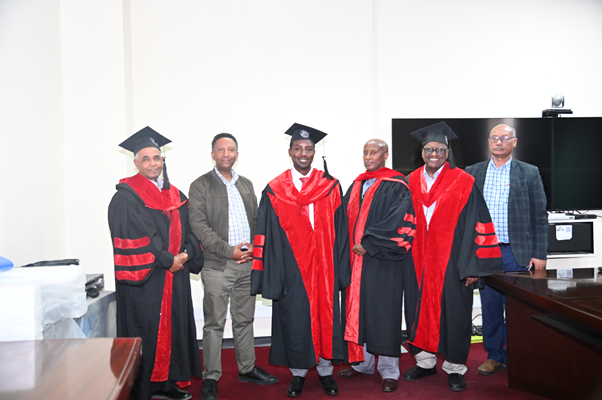
The public defense brought together esteemed scholars and experts in aquatic ecology and environmental science. The session was chaired by Prof. Abebe Getahun (Addis Ababa University) and evaluated by Prof. Brook Lemma (internal examiner, Addis Ababa University) and Prof. Zinabu Gebremariam (external examiner, Hawassa University). The research was supervised by Prof. Tadesse Fetahi and co-supervised by Dr. Demeke Kifle, both from Addis Ababa University.
With this successful defense, Flipos Engdaw Woldeab now joins the ranks of scholars committed to preserving Africa’s vital water resources amid rapid development and environmental change.